
300 Hours Yoga Teacher Training in Rishikesh

Course Highlights

$649

No Food & Accommodation

  • 28 Days Program
  • Certification-Yoga Alliance
  • Study Material Included

$749

Quad Shared Dorm

  • 28 Days Program
  • Certification-Yoga Alliance
  • Study Material Included
  • 3 Yogic Meals

$1149

Twin Shared Room

  • 28 Days Program
  • Certification-Yoga Alliance
  • Study Material Included
  • 3 Yogic Meals

$1349

Private Room

  • 28 Days Program
  • Certification-Yoga Alliance
  • Study Material Included
  • 3 Yogic Meals

Apply for our Apply for our 300 Hour Yoga Teacher Training in Rishikesh and experience a deeper connection with your practice in the beautiful environment of this spiritual city. Designed for those already certified in a 200 hour multi style yoga teacher training course program, It is a chance to understand yoga beyond the basics and spend more time with subjects like alignment, anatomy, pranayama, meditation, sequencing, and teaching.

Many students complete their 200 Hour training feeling confident in the basics but also aware that there is still much more to learn, such as topics about alignment, sequencing, anatomy, adjustments, pranayama, meditation, and working with different types of students, which often arise only after months or years of practice and teaching. The idea behind a 300 Hour training is to create this space to explore these subjects more thoroughly and develop a deeper understanding of yoga practices.

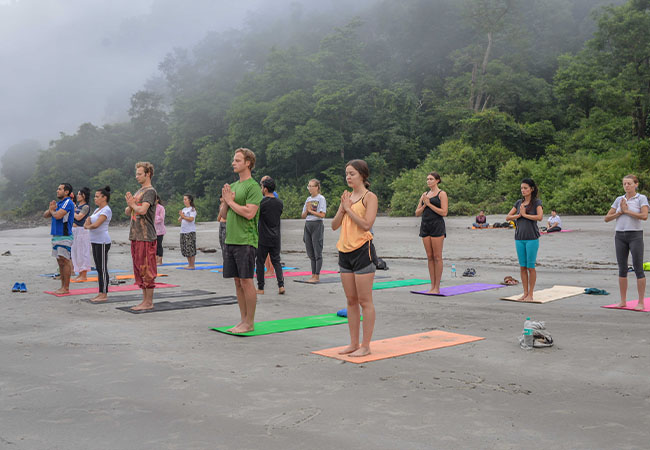
During the training program, our syllabus covers the same subjects, such as the study of Hatha Yoga Asana and Ashtanga Vinyasa, but this time the focus is on more challenging postures from advanced series or categories. Student in asana class are more alignment-focused and try to develop an overall understanding of the principles. By this stage, learning new postures is only a small part of the process. The bigger focus is understanding why a posture works, what can go wrong, and how to make it suitable for different students.

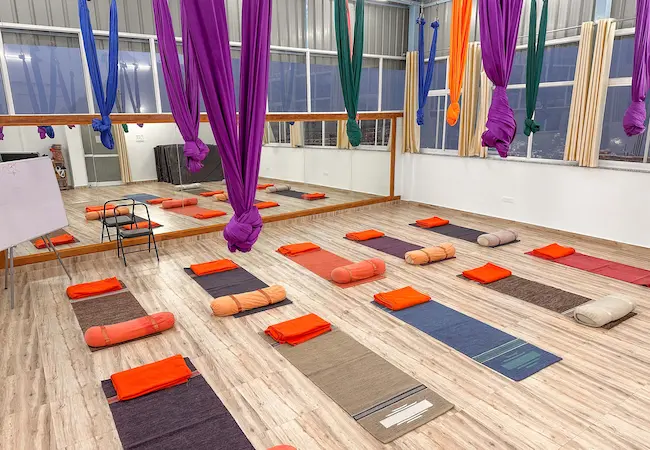
At our Yoga Teacher Training Center, we always advocate small batches to promote student-teacher interactions and enhance the learning experience.

The pranayama and meditation sections also become more detailed in terms of practice. Students study advanced ratio breathing practices, longer internal and external retention, concentration methods, and meditation practices. We do not just practice these techniques and move on. Time is also spent discussing what they are meant to do, how they are traditionally used, and the role they play in yoga practice.

Yoga philosophy and anatomy are studied in greater depth compared to a foundational teacher training program. Students cover the concepts of chitta and vrittis from yogic texts such as the Patanjali Yoga Sutra, and the anatomical principles that support safe movement and effective teaching. Teaching methodology sections are added in each class and focus on observation skills, hands-on adjustments, planning, sequencing, and communication as a yoga teacher.

One of the big aspects of a 300 Hour training is the learning environment itself. Opposite to a foundational course where many students are learning to teach for the first time, in 300 Hour program youll be surrounded by like-minded experienced practitioners or existing teachers from different backgrounds. The discussions become more practical, the questions become more detailed, and students benefit from learning alongside others who have already spent time teaching and practising yoga.

As part of the learning experience, students also have access to additional activities such as sound healing sessions, aerial yoga classes. Study materials, yoga manuals, books, notebooks, and practice equipment required for the course are provided by the school. The course is registered with Yoga Alliance USA and can be combined with a previous 200 Hour certification to meet the educational requirements for the 500 Hour level. Upon successful completion of the training, students receive a Yoga Alliance-recognised 300 Hour Yoga Teacher Training certificate from Adi Yoga Ashram.

What does and doesn't the course fee include?

Sample Certificate

Sample Certificate 300 hour

Certification of: 300 Hour Yoga TTC (Yoga Alliance, USA)

Our 300 Hour Yoga Teacher Training in India is registered with Yoga Alliance USA as a Registered Yoga School (RYS 300). Students who have already completed a Yoga Alliance-recognised 200 Hour Yoga Teacher Training can combine both qualifications to meet the educational requirements for the RYT 500 level.

While the certification is important, many students find that the most valuable part of the course is the month spent living and studying yoga every day. By attending regular classes, and full focused personal practice, and discussions with teachers, students continue developing their teaching skills while building a stronger understanding of yoga and its practices.

300-Hour Yoga Alliance Logo Yoga Alliance Accreditation Logo
Our Yoga Alliance Profile →

Yoga Alliance ID: 388264

Eligibility & Requirements - 300 Hour Yoga Teacher Training Program

The 300 Hour Yoga Teacher Training in Rishikesh is designed for students who have already completed a 200 Hour Yoga Teacher Training and wish to continue their studies. This course is suitable for yoga teachers who want to improve their teaching skills, as well as dedicated practitioners who wish to deepen their understanding of yoga beyond the foundational level.

As this is an advanced training, students should already be familiar with basic yoga postures, pranayama, meditation, yoga philosophy, and teaching terminology. You do not need to be an expert practitioner, but you should be comfortable with regular yoga practice and ready to spend a month studying and practising in a disciplined environment.

The course includes advanced asana practice, pranayama, meditation, anatomy, philosophy, teaching methodology, and long study hours. Students should be prepared for a full daily schedule and be willing to take part in both practical and theoretical classes.

Since the training involves daily physical practice and extended periods of study, students should be in generally good physical and mental health. This course may not be suitable for you if you have any serious physical injury or a chronic medical condition that could affect regular participation in the classes.

All classes and lectures are conducted in English only. So if better if students have a sufficient level of English to understand instructions and discussions, and can follow the theoretical subjects taught during the training.

To join the 300 Hour Yoga Teacher Training, students must hold a valid 200 Hour Yoga Teacher Training certification from a registered Yoga Alliance yoga school.

Course Syllabus - 300 Hours Yoga Teacher Training

We have designed 300 Hours YTTC program syllabus to fulfill the objectives containing philosophical and practical aspects of Yoga. The daily schedule of a program includes the advanced theory and practice of the different yogic techniques or practices. The practices of yoga involve alignment and assistance techniques. In this course, students will learn the teaching skills and practice advanced level yoga teaching. This 28-day yoga course will teach you communication skills in yoga teaching practice. Students will learn about anatomy and physiology and their applications. You will also learn about Yoga Philosophy, Therapeutics of yoga practices, Yoga Nidra, and ethics for yoga teachers.

Asana Practice & Technique

Ashtanga Vinyasa Yoga Asana

Students will gain extensive knowledge on yoga postures and will increase their strength, flexibility and discipline at Adi Yoga Ashram Rishikesh India.

Primary Series Acceleration (Initial Days)

  • Complete Primary Series to reset and revise the fundamental
  • Foundational transitions, jump-backs, and jump-throughs

Introduction to the Nadi Shodhana Sequence (Intermediate / Second Series)

  • Pasasana to Krounchasana
  • Backbending Progression
  • Heart Openers (Ustrasana to Kapotasana)
  • Opening & Pelvic Sequence
  • Advanced seated twists
  • Forearm balance inversions
Hatha Yoga Asana

The word haṭha literally means "force" and thus alludes to a system of physical techniques. In India hatha yoga is associated in popular tradition

Structural Warm-Up & Joint Preparation

  • Warm-ups targeting the ankles, knees, pelvic girdle, wrists, and shoulder
  • Sun Salutations
  • Basic standing and structural postures as prepration

Advanced Peak Postures

  • Individual and Sequences based on balancing & Arm Balances Poses (e.g: Crow, Mayurasana,Eka Pada Koundinyasana)

Advanced Backbending & Drop-Backs

  • Chakrasana (Wheel Pose) variations.
  • controlled drop-back into Wheel

Categories & Deep Static Holdings

  • Inversion (Sirshasana (Headstand), Sarvangasana (Shoulder stand) variations)
  • Thoracic Backbending (Raja Kapotasana (King Pigeon))
  • Hip Integration & Seated Postures (admasana (Lotus Pose), Hanumanasana (Front Splits))
  • Seated Twists & Forward Extensions

Subtle Energy Practices

Chanting

Rather than being studied only in theory, mantra chanting is integrated into the daily rhythm of the course. Through regular repetition and practice, students develop a deeper familiarity with traditional chants and their role in concentration, meditation, and yogic practice.

  • Om Asato Ma Sadgamaya (Mantra from the Upanishads)
  • Tvameva Mata Cha Pita Tvameva (Prayer Verse)
  • Om Tryambakam Yajamahe (Maha Mrityunjaya Mantra)
  • Om Sahana Vavatu (Mantra from the Upanishads)
  • Guru Brahma Guru Vishnu Gurur Devo Maheshwara (Guru Stotram)
  • Yogena Chittasya (Invocation to Sage Patanjali)
  • Hare Rama Hare Krishna (Maha Mantra)
Pranayama Practices (Expension of Vital Energy)

Pranayama is one of the central practices of yoga and plays an important role in preparing the mind for meditation. In the 300 Hour training, students move beyond the basic techniques and spend more time exploring breath ratios, retention practices, and the relationship between breath, mind, and the nervous system.

Foundations

  • Review of the traditional definitions of Pranayama
  • Advanced understanding of the five Prana Vayus
  • Four stages of breath: Puraka, Antar Kumbhaka, Rechaka, Bahir Kumbhaka

Respiratory & Pressure Mechanics

  • diaphragm mechanics
  • Intra-abdominal and intrathoracic pressure
  • Breath observation and correction techniques

Kumbhaka & Breath Ratios

  • Introduction to Antar Kumbhaka
  • Introduction to Bahir Kumbhaka
  • Breath ratios
  • Effects of breath retention on body and mind
  • Contraindications and safety guidelines

Pranayama Practices

  • Nadi Shodhana, Ujjai,Bhastrika,Kapalbhati, Surya and Chandra Bhedi
  • Sheetali, Sheetkari, Bhramri

Bandha Integration

  • Jalandhara Bandha prepration and practice
  • Uddiyana Bandha prepration and practice
  • Mula Bandha prepration and practice

Practice Challenges & Teaching Methodology

  • Stress and breathing patterns
  • Role of exhalation and relaxation
  • Common breathing difficulties
  • Common issues faced by students
  • Teaching progression and sequencing
  • Voice modulation and class guidance
Yoga Cleansing (Shatkarma)

Shatkarma includes a group of traditional cleansing techniques used in Hatha Yoga. These practices help prepare the body for pranayama and meditation while teaching students the importance of proper preparation, hygiene, and awareness in yoga practice.

  • Jalaneti Satkarma (Nasal cleansing with salty water)
  • Rubber neti (Nasal cleansing with a rubber string)
  • Kunjal Kriya
  • Agnisar Kriya
Meditation (Dhyana)

Meditation helps calm the mind and develop greater awareness. In this subject, students explore different meditation techniques and learn how regular practice can improve concentration, emotional balance, and overall well-being while supporting deeper stages of yoga.

Foundations of Meditation

  • Introduction to Meditation
  • Meditation Postures
  • Do's and Don'ts of Meditation
  • Importance of Breath in Meditation
  • Importance of Grounding Practices

Awareness & Mindfulness Practices

  • Mindfulness Meditation
  • Breath Awareness Meditation
  • Body Scanning Meditation

Concentration & Sensory Meditation

  • Trataka Meditation
  • AUM Chanting Meditation
  • Nadabrahma Meditation

Mantra & Yogic Meditation

  • Japa Meditation
  • Ajapa Japa Meditation

Chakra & Guided Meditation

  • Guided Chakra Meditation
  • 61-Point Guided Meditation
  • Yoga Nidra Practice
  • Chakra Yoga Nidra Practice

Dynamic Meditation Practices

  • Gourishankar Meditation
  • Osho Mandala Meditation

Biomechanics of Body

Anatomy and Physiology

A good understanding of anatomy helps students practice and teach yoga more safely. In this subject, we study how the body moves, breathes, and responds to different postures.

Advanced Movement Anatomy

  • Review of anatomical planes and movement directions
  • Advanced joint actions in yoga postures
  • Understanding movement patterns in asana practice
  • Relationship between mobility, stability, and flexibility
  • Body mechanics during advanced yoga postures

Spine, Pelvis & Postural Mechanics

  • Detailed study of spinal movements and spinal safety
  • Natural curves of the spine and postural deviations
  • Pelvic alignment and its role in yoga practice
  • Lower back stability and common movement mistakes
  • Application of spinal awareness in forward bends, twists, and backbends

Shoulder, Hip & Knee Anatomy

  • Shoulder joint structure and movement mechanics
  • Scapular stability and upper body strength
  • Hip joint mobility and pelvic control
  • Knee alignment and injury prevention
  • Safe practice principles for weight-bearing postures

Muscular System & Functional Anatomy

  • Major muscle groups used in advanced asana practice
  • Muscle engagement and release in yoga postures
  • Understanding agonist and antagonist muscle actions
  • Role of core muscles in stability and balance
  • Functional use of muscles in sequencing and teaching

Applied Anatomy for Teaching

  • Reading body alignment in yoga postures
  • Understanding common compensation patterns
  • Adapting postures for different bodies and limitations
  • Use of props for safe alignment and support
  • Anatomy-based verbal cues and hands-on adjustments

Injury Prevention & Safe Practice

  • Common yoga injuries and their causes
  • Safe progression in advanced postures
  • Understanding pain, discomfort, and warning signs
  • Modifications for students with limited mobility
  • Creating safe and balanced yoga sequences

Advanced Philosophy & Meditative Practices

Yoga Philosophy (Yoga Darshana)

Yoga philosophy gives meaning and direction to the practice of yoga. Through the study of traditional teachings, students learn about self-discipline, personal growth, the nature of the mind, and how yogic principles can be applied both on and off the mat.

  • Overview of the topics from 200 Hour
  • Important topics from Yoga Sutra
  • Chitt and Vritti - 1.2 to 11
  • Abhyas and Vairagy-1.12
  • Three kinds of practitions-1.21
  • Ishvar-1.24 to 29
  • Antaray-1.30
  • Chitt Prasadan-1.33
  • Kriya Yog-2.1
  • Panch Klesh-2.3 to 2.13
  • Seven grounds of Knowledge-2.27
  • Siddhi-4.1 (Brief Discussion-Optional)
  • Kaivaly-4.33 (Brief Discussion-Optional)

Criteria of Assessment for 300 Hour Yoga TTC Program

Students are assessed throughout the 300 Hour Yoga Teacher Training through both written and practical evaluations. These assessments help students understand their progress, refine their practice, and develop more confidence in their teaching.

Practical assessments include asana teaching, alignment understanding, adjustment skills, pranayama practice, class sequencing, and the ability to guide a complete yoga class.

The purpose of assessment is not only to test knowledge, but also to support each student in becoming a more confident, responsible, and well-prepared yoga teacher.

Assessments Are Based On:

  • • Practical teaching performance
  • • Written examination
  • • Professional behavior and discipline
  • • Attendance and punctuality

Why Choose Adi Yoga Ashram for Your 300 Hour Yoga TTC Program?

A 300 Hour Yoga Teacher Training is an opportunity to spend more time with the deeper aspects of yoga. Other then advanced asana, students also explore the practices of pranayama, meditation, anatomy, philosophy, and teaching methodology in depth detail The course is designed for practitioners and teachers who wish to continue learning, refine their skills, and build a stronger understanding of yoga as a whole.

Adi Yoga Ashram

Go Beyond the Foundations

  • A 200 Hour training gives you the basics. The 300 Hour course gives you more time to explore subjects such as advanced asana, pranayama, meditation, anatomy, philosophy, and teaching methodology in greater depth.
  • Study Both Hatha and Ashtanga Yoga

  • Instead of focusing on a single style, the course combines Advanced Hatha Yoga and Ashtanga Vinyasa Yoga, this helps students experience different approaches to practice and develop a broader understanding of teaching.
  • Teaching Beyond One-Size-Fits-All Yoga

  • Students in 300-hour programs come from a variety backgrounds, it can be different strengths, limitations or goals. So during the training, you get to learn how to observe movement patterns, make practical modifications, and use props for different bodies and abilities.
  • Break Down Advanced Postures Step by Step

  • Advanced postures are studied through a gradual and systematic approach. Students learn the preparation work, strength requirements, alignment principles, common mistakes, and safe progressions needed for arm balances, backbends, inversions, and other challenging postures.

Excursion Included In This Course

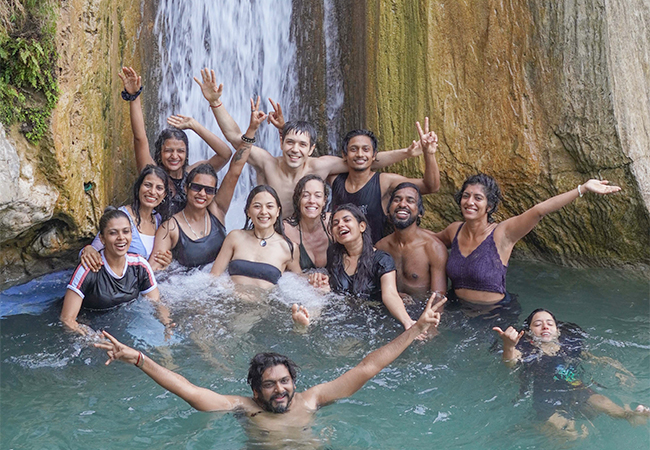
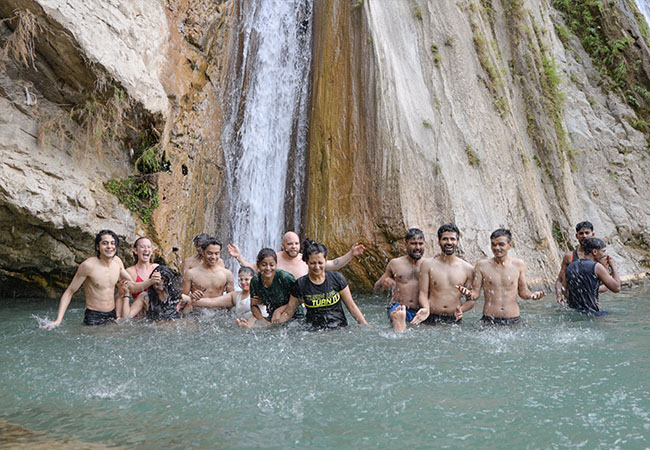
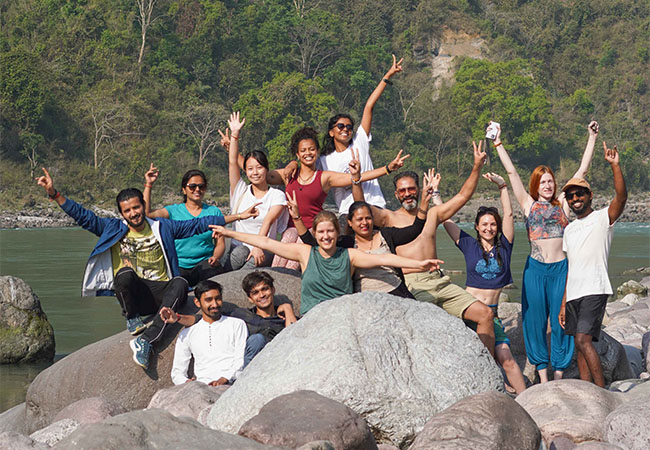
The 300 Hour Yoga Teacher Training includes three guided Sunday excursions during the whole course. These outings give students an opportunity to relax, explore the famous spots of the city, and enjoy a break from the regular training schedule. Sundays are kept free from classes, and only breakfast is served at the school, allowing students to make the most of their free day and enjoy the varity of food served in the local restaurents and cafes.

Student Accommodation & Facilities in Rishikesh

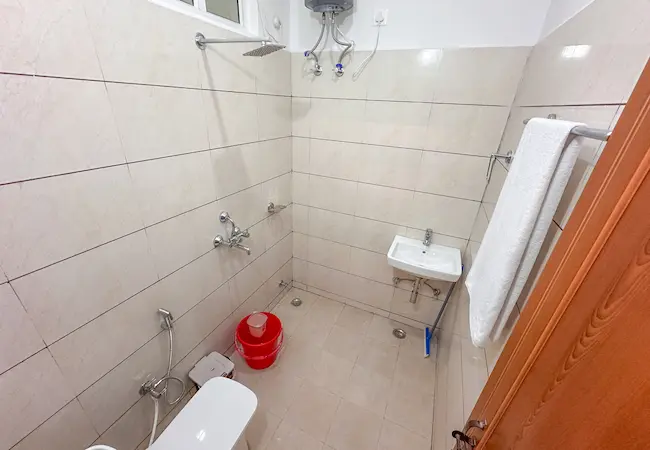
Students can choose between private rooms, twin shared rooms, or dormitory accommodation. All rooms are clean, comfortable, and come with attached bathrooms.

  • Room Size: 11 × 11 ft to 12 × 12 ft (≈ 12–13 m²)
  • Bathroom: Attached, 3 × 6 ft to 5 × 6 ft with (electric water heater), western toilet, and standard shower fittings.
  • Beds: Private (6 x 6 ft) ,Twin Shared (2 × single 6 × 3 ft); Dorm (2 Bunk beds 6 x 3 ft) foam mattresses medium firmness, polyester fiberfill Pillow medium firmness
  • Storage: One Cupboard/Room (6′10″ × 3′) shared by students

*Layouts may vary slightly between rooms in the same category.

Facilities/Amenities

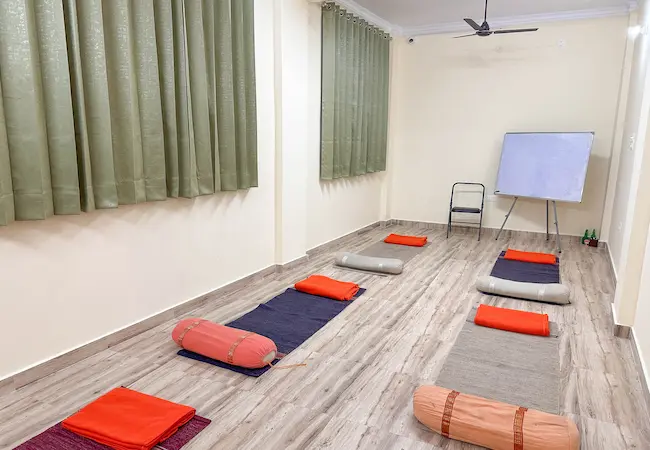
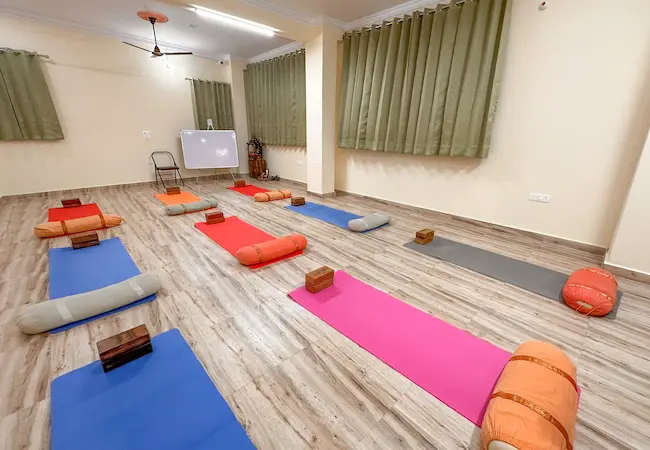
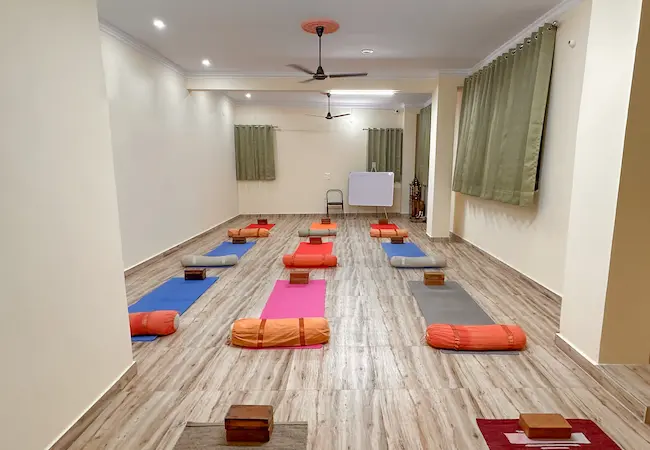
  • Air-Conditioned 3 Yoga Studios
  • Attached Bathroom
  • Free Wi-Fi ~40–60 Mbps
  • Electric Geyser
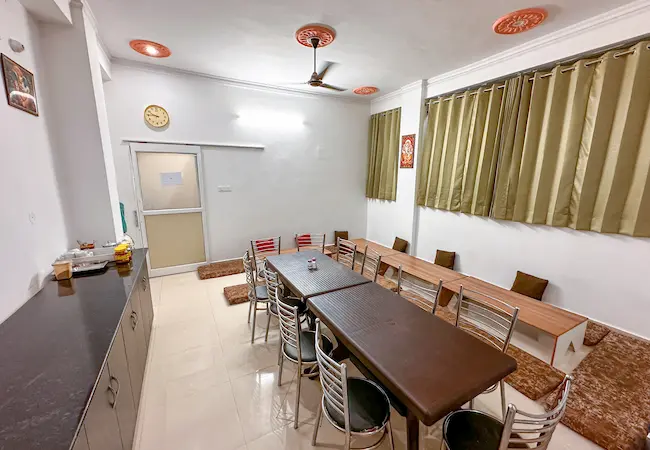
  • Dining Area
  • Study Desk and Chair
  • Purified Drinking Water (Hot, Cold & Normal)
  • Storage Cupboard
  • In-Room AC (Chargeable)
  • Shower
  • Shared Student Fridge (Dining Area)
  • Linen Change Every 3rd Day
  • Terrace
  • Weekly Housekeeping
  • Nearby Laundry Facilities (5-min walk)

Meals

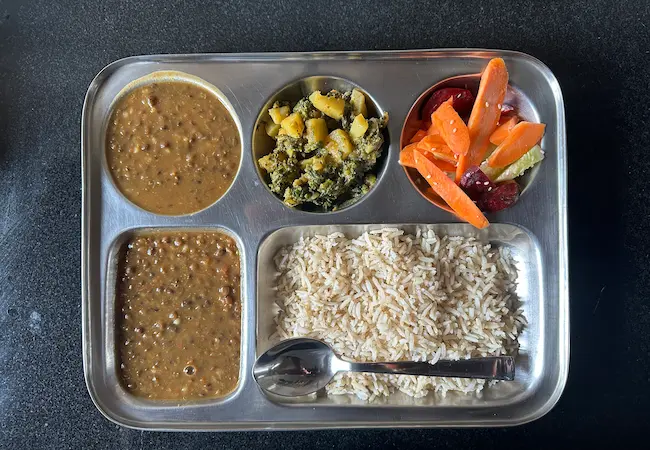
Students are served three freshly prepared vegetarian meals each day, including breakfast, lunch, and dinner. The meals are simple, nourishing, and designed to support an active yoga lifestyle. Herbal tea is also served daily.

Special Dietary Needs: We can accommodate Vegan and Gluten-Free requests with prior notice. To ensure we can meet your safety and nutritional needs, please read our Full Dietary & Allergy Policy here.

  • Breakfast: includes oats, fruits, sprouts and dishes like poha, idli, or dosa, rolls etc.
  • Lunch: offers rice with lentils, seasonal vegetables, and salad.
  • Dinner: is light and comforting with soup , Chapati & Rice, lentils, Occasional sweets, herbal tea, and seasonal vegetables.
  • Highlight: No onion, no garlic, Prepared with minimal oil, Balanced with protein, carbs, and micronutrients

" आत्मवान् यो जनाति सर्वं तत्र को मोहः कः शोकःयोगः "

"One who knows the self sees everything in the self, and there is no more delusion or sorrow."


Brihadaranyaka Upanishad 4.4.22

Course Dates - 300 Hours Hatha Ashtanga Yoga Program

Note:- During major holidays in India, such as Diwali, Holi, and Raksha Bandhan, please note that classes will not be conducted as per the regular schedule. Additionally, it is important to be aware that the graduation date for the course may be extended by a day to accommodate these holiday breaks.

Discount Offers: Take advantage of our offers! These discounts are designed to support your yoga journey and make your training more accessible. Please read the guidelines carefully to understand how and when each offer can be applied.

🎁 Early Bird

Book 20 days before & get 5% off your total fee (Everymonth for First 5 bookings).

🎁 Enroll Together (Friends Discount)

Sign up together with a friend and you both receive 8% off.

🎁 Birthday Month Discount

If your course falls in your birthday month, enjoy additional 2% off as our gift to you!.

🎁 Group Discount

Enroll as a group of 4 or more and get 10% off per person.

Answers of Most asked QUESTIONS

Frequent Asked Questions

A 200 Hour Yoga Teacher Training focuses on building a foundation for a beginner in both yoga practice and teaching. On the other hand the 300 Hour program is designed for students who already completed the 200 hour program and have that foundation but they want to continue learning to improve the knowledge. In this program the subjects are covered in more depth.

No, 300 Hour Yoga Teacher Training program is an advanced-level program and all stuednt requires prior training before they can apply for the program. Minimum requirement is that a students must have a valid 200 Hour Yoga Teacher Training certification from yoga alliance affilated school before joining this course.

Yes. If you have already completed a Yoga Alliance recognized 200 Hour Yoga Teacher Training, you can combine it with your 300 Hour certification to meet the educational requirements for the RYT 500 level.

The course gives students more time to deepen their knowledge of yoga and improve their teaching. And it also allows practitioners to study all topics in depth, to refine their personal practice, gain more teaching experience, and develop greater confidence when working with different types of students.
For many yoga teachers and dedicated practitioners, the answer is yes. A 200 Hour course provides the foundation, but a 300 Hour training offers the opportunity to spend more time with the subjects that often need years of study and practice to understand. It is a chance to continue learning, ask deeper questions, and grow both as a practitioner and a teacher.

Read more Faq's